Navigating US Med Spa Regulations and Compliance
Med spa regulations are state-specific legal frameworks governing the operation of medical spas, ensuring that clinical aesthetic treatments are performed safely under proper medical supervision. These laws dictate who can own a facility, the necessary licenses for practitioners, and the level of oversight required by a designated medical director.
State-Specific Ownership and the CPOM Doctrine
Most states follow the Corporate Practice of Medicine (CPOM) doctrine, which prohibits non-physicians from owning a medical practice or employing physicians. Med spa regulations in these jurisdictions typically require that a licensed physician or a physician-owned corporation holds majority ownership of the business.
In states where CPOM is strictly enforced, non-medical entrepreneurs often utilize a Management Services Organization (MSO) model. This structure allows a business entity to handle administrative tasks while the medical entity focuses on clinical care.
Failure to comply with ownership laws can lead to charges of practicing medicine without a license. It is essential to verify your specific state board of medicine requirements before finalizing your business structure.
Licensing and Medical Supervision Requirements
Every med spa must operate under the license of a designated medical director. This individual is responsible for the clinical oversight of all medical procedures, including cosmetic injections and high-energy laser treatments.
Supervision requirements vary significantly by state, with some requiring the medical director to be physically present on-site. Other states allow for off-site supervision, provided the director is readily available via telecommunication.
- Good Faith Exams: A physician, NP, or PA must perform an initial physical exam before a patient receives medical treatment.
- Delegation: Medical directors must formally delegate tasks only to individuals whose professional license allows for such procedures.
- Mid-Level Providers: Many states allow Nurse Practitioners (NPs) and Physician Assistants (PAs) to act as autonomous or semi-autonomous providers.
Legal Scope of Aesthetic Practice
The legal scope of practice defines which procedures specific practitioners can perform based on their professional licensure. Med spa regulations distinguish between medical procedures and general esthetician services.
Injectables like Botox and dermal fillers are considered medical treatments, meaning they cannot be administered by unlicensed individuals or standard estheticians in most states. Registered Nurses (RNs) often perform these under supervision.
Laser hair removal and skin resurfacing also fall under medical oversight in many jurisdictions. Providers must ensure that every staff member operates strictly within the boundaries of their state-issued professional license.
Inspection Readiness and Compliance Documentation
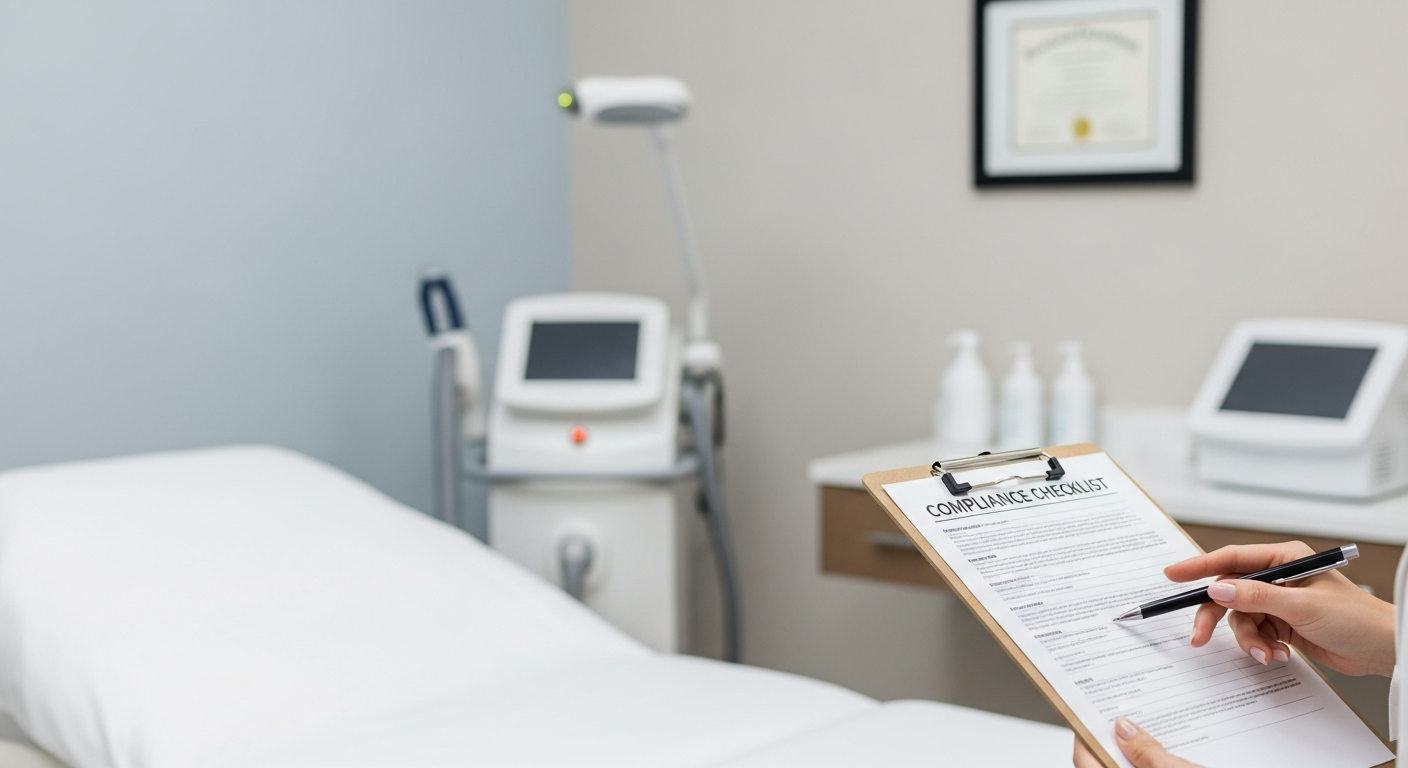
State boards of medicine and nursing may conduct unannounced inspections to ensure facility safety. Maintaining rigorous compliance documentation is the best defense against citations or license suspension.
Standard Operating Procedures (SOPs) must be written, signed by the medical director, and accessible to all staff. These documents outline the protocols for every medical treatment offered at the facility.
- Patient Records: Maintain detailed charts including consent forms, treatment logs, and pre/post-procedure photos.
- Adverse Event Logs: Document any complications and the subsequent clinical actions taken to resolve them.
- OSHA Standards: Ensure compliance with bloodborne pathogen training and proper biohazardous waste disposal.
Maintaining HIPAA and Privacy Standards
Because med spas provide medical treatments, they are subject to the Health Insurance Portability and Accountability Act (HIPAA). This requires the secure storage of protected health information (PHI) in digital and physical formats.
Compliance involves using encrypted communication tools and ensuring that patient privacy is maintained during consultations. Staff training on privacy laws should be conducted and documented annually.
