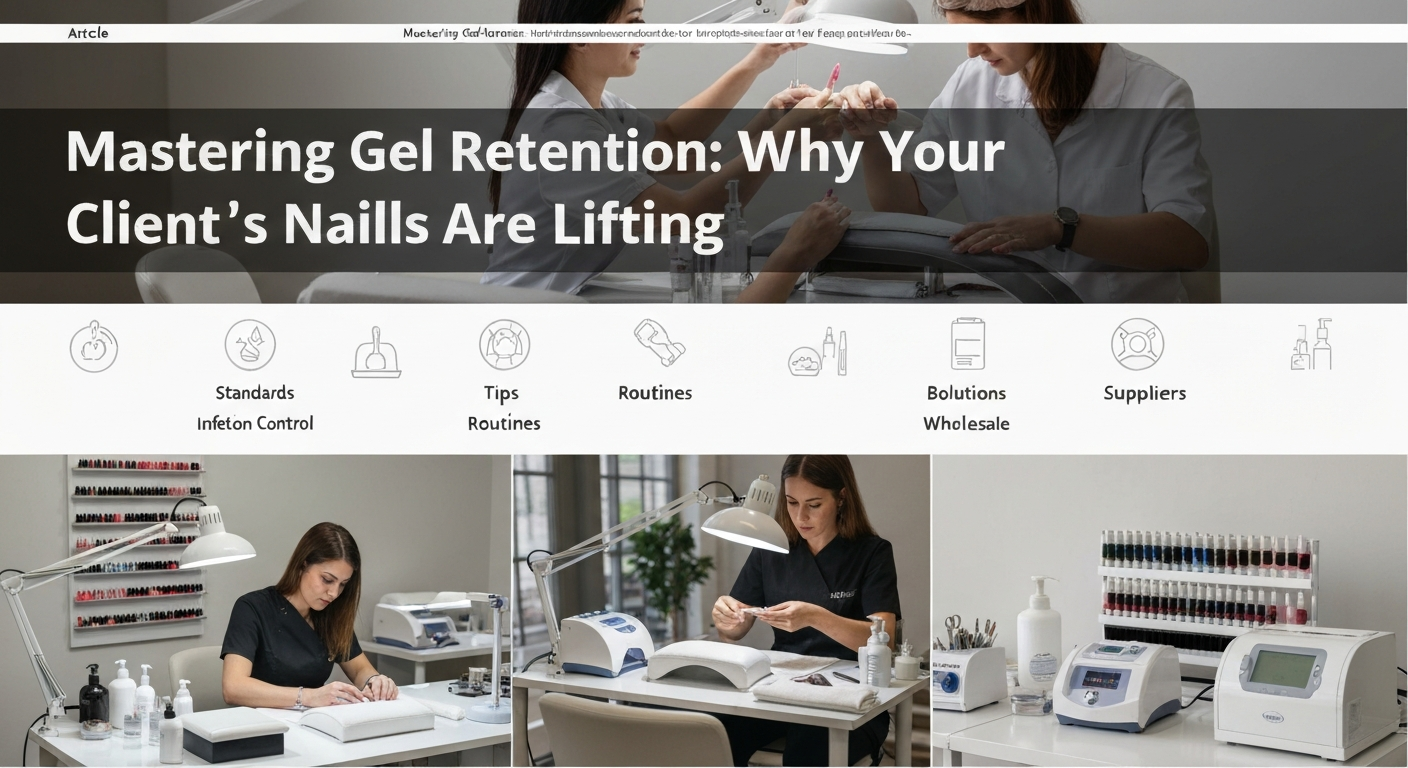
Mastering Gel Retention: Why Your Client’s Nails Are Lifting
Service breakdown is the most frustrating issue for any professional nail technician.
When clients return with lifting gel polish after only a few days, it impacts your reputation and income.
Understanding the chemistry and mechanics of adhesion is vital for salon success.
Most lifting issues are not caused by defective products, but by application or preparation errors.
By refining your workflow, you can ensure 3+ weeks of wear for your clientele.
Here are the five most common reasons for premature lifting and how to fix them.
1. Incomplete Removal of Non-Living Tissue
The number one cause of lifting is product adhering to skin rather than the nail plate.
The cuticle is dead skin on the nail plate, often invisible to the naked eye.
If you apply base coat over this tissue, the product will lift as the skin sheds oil.
Proper Cuticle Prep Standards
Use the right tools: Utilize a sharp stainless steel pusher or a curette.
E-file techniques: If certified, use a fine-grit diamond bit to gently exfoliate the cuticle area.
Check your work: Ensure the proximal nail fold is clean and the plate is free of debris.
2. Improper Surface Preparation
Gel polish requires a textured surface to form a mechanical bond.
If the nail plate is too smooth, the product has nothing to grip onto.
Conversely, over-filing damages the nail and thins the foundation, leading to flexibility issues.
- Use a 180-grit buffer or file: Gently remove the shine from the entire nail plate.
- Focus on the perimeter: Pay special attention to the cuticle area and sidewalls.
- Remove dust thoroughly: Dust particles trapped under gel will cause instant pockets of air.
3. Failure to Dehydrate and Cleanse
Nail plates are naturally porous and contain oils and moisture.
Applying product directly onto an oil-rich plate blocks adhesion.
A specific cleansing step is mandatory before applying any primer or base coat.
The Two-Step Prep System
Step 1 – Cleanser: Scrub the nail with pure acetone or 99% isopropyl alcohol using a lint-free wipe.
Step 2 – Dehydrator: Apply a pH bond agent to strip surface moisture temporarily.
Timing is key: Apply your base coat immediately after the primer dries to prevent re-contamination.
4. Flooding the Cuticle and Sidewalls
Product control is a skill that separates novice nail techs from experts.
If wet gel touches the skin and is cured, it creates a ledge.
Water, oil, and bacteria will seep under this ledge, forcing the product away from the nail.
Leave a margin: Always leave a tiny, invisible margin between the product and the skin.
Clean before curing: If product touches skin, remove it with a cleanup brush and alcohol before the hand goes in the lamp.
Thin layers:Thick layers are harder to control and more likely to run into the sidewalls.
5. Inadequate Curing or Lamp Issues
Under-cured product is a safety hazard and a primary cause of lifting.
If the UV or LED light does not penetrate the entire layer, the bottom remains soft.
This creates a weak foundation that peels away from the nail plate easily.
Optimizing Your Curing Process
Check hand placement: Ensure the client’s thumb is flat and not tilted sideways.
Bulb strength: If using a UV lamp, change bulbs regularly. For LED, ensure the unit is clean.
Compatibility: Use the lamp recommended by your gel system manufacturer for the correct wavelength.
Improving Your Salon’s Retention Rate
Troubleshooting lifting requires a systematic review of your table habits.
Focus on meticulous prep and strict moisture control.
By mastering these standards, you build a loyal client base that trusts your professional expertise.
