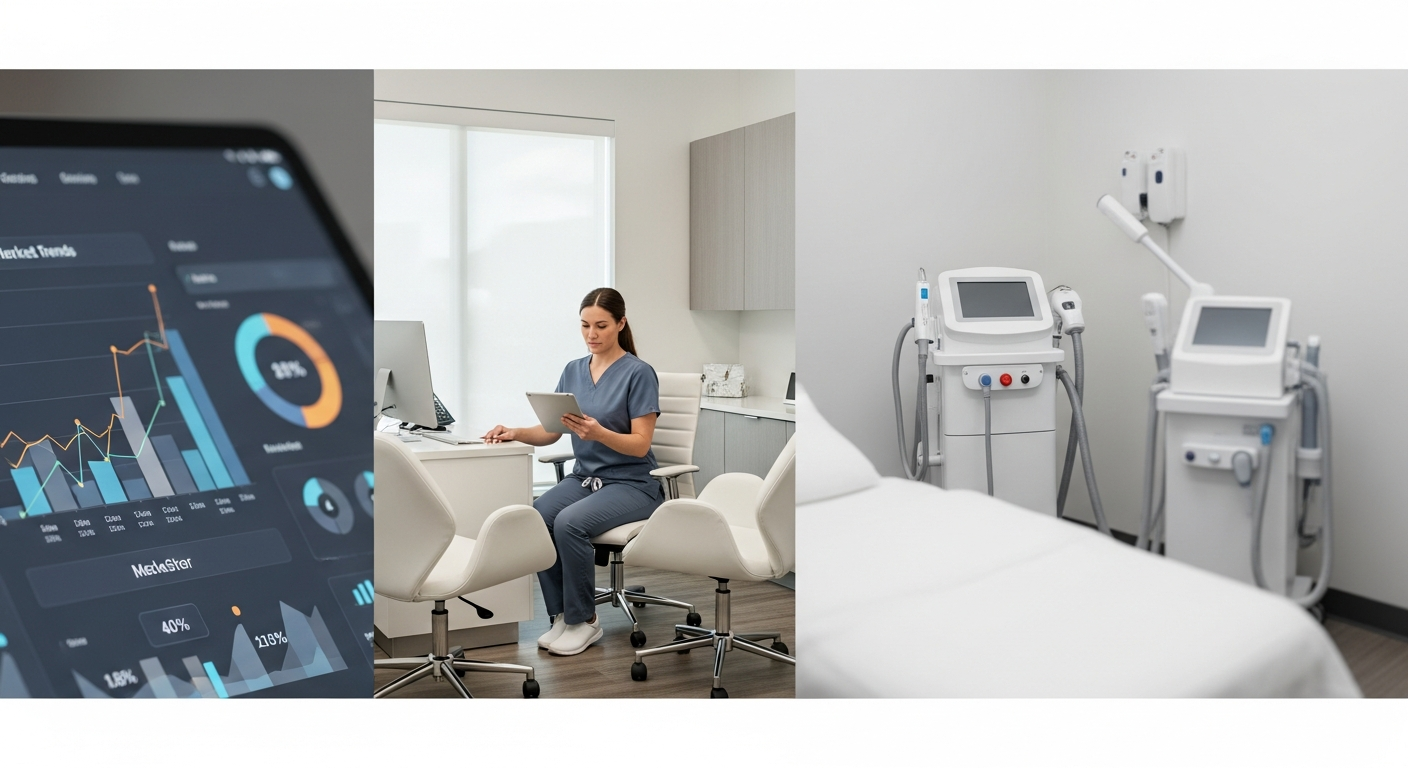
U.S. Med Spa Industry Statistics and Market Trends
U.S. med spa industry statistics indicate a market valuation exceeding $18 billion, with a projected compound annual growth rate of approximately 10%. This data reflects significant expansion in non-invasive aesthetic procedures, primarily driven by neuromodulators and dermal fillers, while maintaining a high average revenue per patient within domestic medical aesthetic clinics.
National Market Valuation and Economic Outlook
The U.S. med spa sector continues to outpace traditional retail healthcare in annual growth.
Market data suggests the industry will reach a valuation of $30 billion by 2030.
This trajectory is supported by increased consumer accessibility and demographic expansion.
Average Revenue and Profitability Metrics
The average revenue for a single-location U.S. med spa is approximately $1.9 million.
Profit margins typically range between 20% and 25% for well-managed facilities.
Labor costs remain the largest operational expense, often exceeding 35% of gross revenue.
Primary Treatment Growth and Utilization Rates
Injectable treatments represent the largest share of service volume in the United States.
Neuromodulator applications have seen a consistent year-over-year increase of over 12%.
Dermal fillers follow closely as the second most requested non-surgical procedure.
Energy-Based Device Trends
Laser hair removal and skin resurfacing treatments maintain high utilization rates.
Body contouring technologies are experiencing rapid adoption in suburban market segments.
These services provide high-margin returns due to lower consumable costs per session.
Clinical Safety and Complication Analysis
Industry safety data indicates that major complication rates remain below 1% nationally.
However, vascular occlusions from dermal fillers represent a critical clinical focus area.
Standardized training protocols are increasingly implemented to mitigate these adverse events.
Adverse outcomes are more frequently documented in facilities lacking direct physician oversight.
Data suggests that “non-core” providers have a higher statistical likelihood of procedural errors.
Reporting accuracy is improving as state boards mandate better clinical documentation.
Evolving Regulatory and Compliance Trends
State medical boards are tightening regulations regarding the Corporate Practice of Medicine.
Compliance data shows an increase in audits related to “Good Faith Exams” (GFE).
Proper delegation of medical tasks is currently the primary focus of regulatory enforcement.
Supervision and Delegation Standards
Requirements for mid-level practitioner oversight vary significantly across the 50 states.
Recent legislative shifts in several states now require physical on-site presence of a director.
Facility licensure and mid-level autonomy levels are undergoing active legal reclassification.
Market Development and Investment Insights
Private equity involvement in the med spa sector has increased by 30% since 2021.
Consolidation is a major trend, with multi-unit platforms acquiring independent clinics.
This shift toward MSO models aims to standardize operational data and clinical safety.
Investor interest is currently focused on high-retention service models and memberships.
Data indicates that subscription-based med spas experience 40% higher patient lifetime value.
Geographic expansion is most aggressive in the Sun Belt and Southeast regions.
