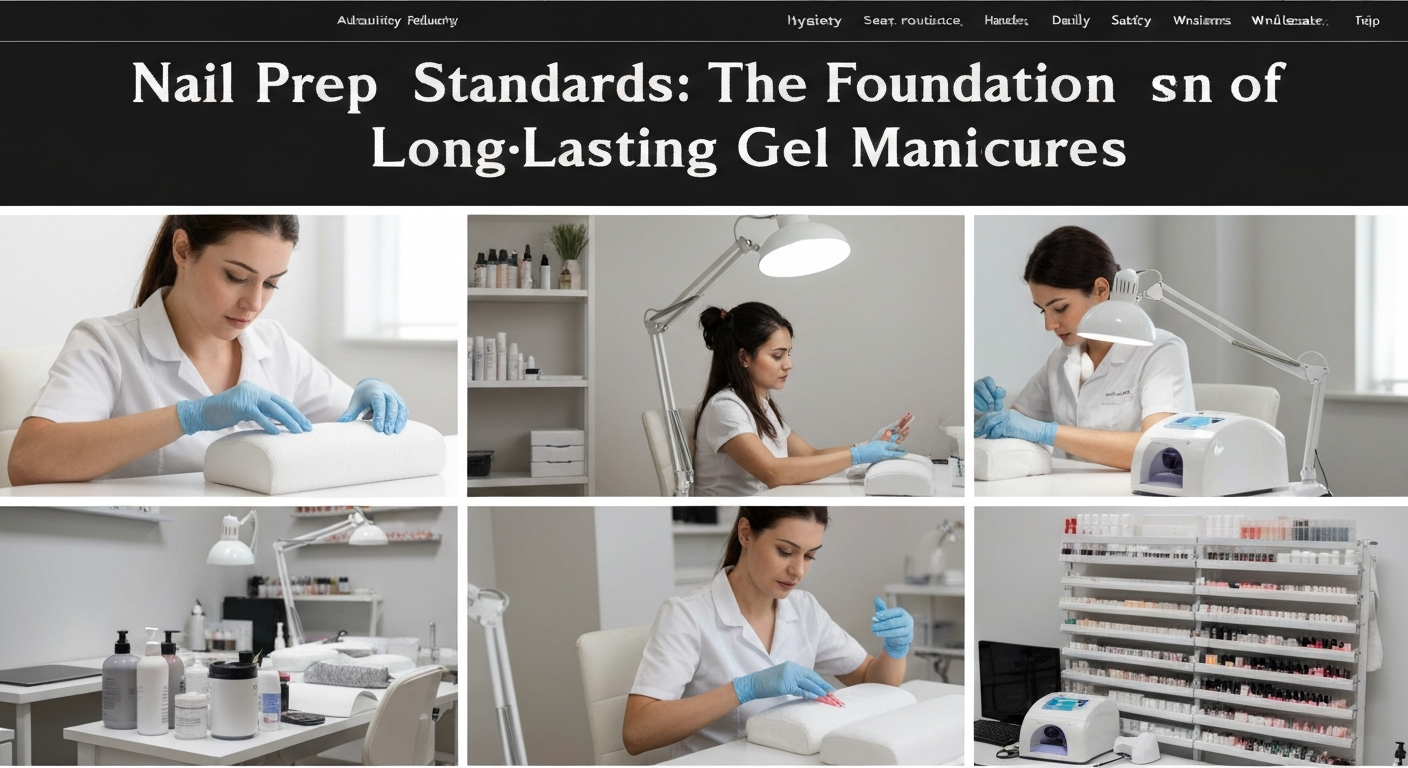
Nail Prep Standards: The Foundation of Long-Lasting Gel Manicures
For any professional nail technician, service breakdown is the ultimate nightmare. Nothing damages a nail salon’s reputation faster than clients returning with chipped or peeling gel polish after only a few days.
Adhesion is not about the brand of polish you use; it is fundamentally about the preparation of the natural nail plate. Mastering this workflow is the industry standard for ensuring retention.
This guide covers the technical standards for nail preparation, focusing on the mechanical and chemical steps required to bond gel product to the natural keratin structure effectively.
Understanding the Enemy: Pterygium and Dead Tissue
The most common cause of lifting occurs at the cuticle area. This is rarely due to the product touching the skin, but rather the failure to remove the non-living tissue on the nail plate.
The “cuticle” that clients refer to is often the eponychium (living skin). As a technician, your focus must be on the true cuticle, which is the thin layer of dead skin cells stuck to the nail plate.
If gel is applied over this remaining tissue, the product bonds to the skin cells, not the nail. As the skin sheds naturally, the product lifts away, creating a pocket for water and bacteria.
Step-by-Step Tissue Removal
- Soften safely: Use a professional cuticle remover if performing a dry manicure, or utilize an e-file with a diamond bit for dry Russian-style prep if certified.
- Push back gently: Use a stainless steel pusher to separate the eponychium from the nail plate, exposing the line of true cuticle.
- Exfoliate: Ensure all white, flaky residue is scraped from the plate, particularly in the sinuses (corners) of the nail.
Mechanical Preparation: Surface Texture
Gel polish requires a textured surface to create a mechanical bond. A nail plate that is too smooth, often caused by over-buffing with high-grit buffers, provides no “grip” for the base coat.
Conversely, using a file that is too coarse can thin the nail plate, making it flexible and prone to bending, which fractures the hard gel layer on top.
The Industry Standard: Use a 180-grit to 240-grit sponge buffer or soft file. The goal is to remove the surface shine (lipids and oils) and create microscopic scratches, not to remove layers of keratin.
Chemical Preparation: Dehydration and Ph Balancing
Once the dust is removed, the nail plate must be chemically prepared. Water, oil, and soap residue are the enemies of adhesion.
Do not rely solely on acetone. While acetone cleans, it does not always deeply dehydrate or adjust the pH of the nail plate to an alkaline state optimal for bonding.
The Two-Step Chemical System
- Cleansing: Use a lint-free wipe saturated with 99% Isopropyl Alcohol or a specialized nail cleanser to remove dust and surface oils.
- Dehydrator: Apply a dehydrator liquid. You should see the nail plate turn a chalky white instantly as moisture evaporates.
- Primer/Bonder: Apply a non-acid primer sparingly. This acts as double-sided tape, bonding the keratin to the oligomers in the gel base.
Base Coat Application and Polymerization
The application of the base coat is the final step of preparation. A common error in busy nail salons is applying the base coat too thickly.
Thick layers of uncured gel can shrink significantly during polymerization in the LED/UV lamp, pulling away from the free edge and cuticle line.
Technique Tip: Use a scrubbing motion with your brush to work the base coat into the textured surface you created during buffing. This ensures the product penetrates the upper layers of the nail plate.
Summary of Best Practices
To reduce service breakdowns and lifting in your salon operations, adhere to these strict protocols:
- Never apply gel over non-living tissue or cuticle residue.
- Remove surface shine without thinning the natural nail plate.
- Use specific dehydrators and primers, not just acetone.
- Ensure your curing lamp has the correct wavelength (nanometers) for your specific gel system.
