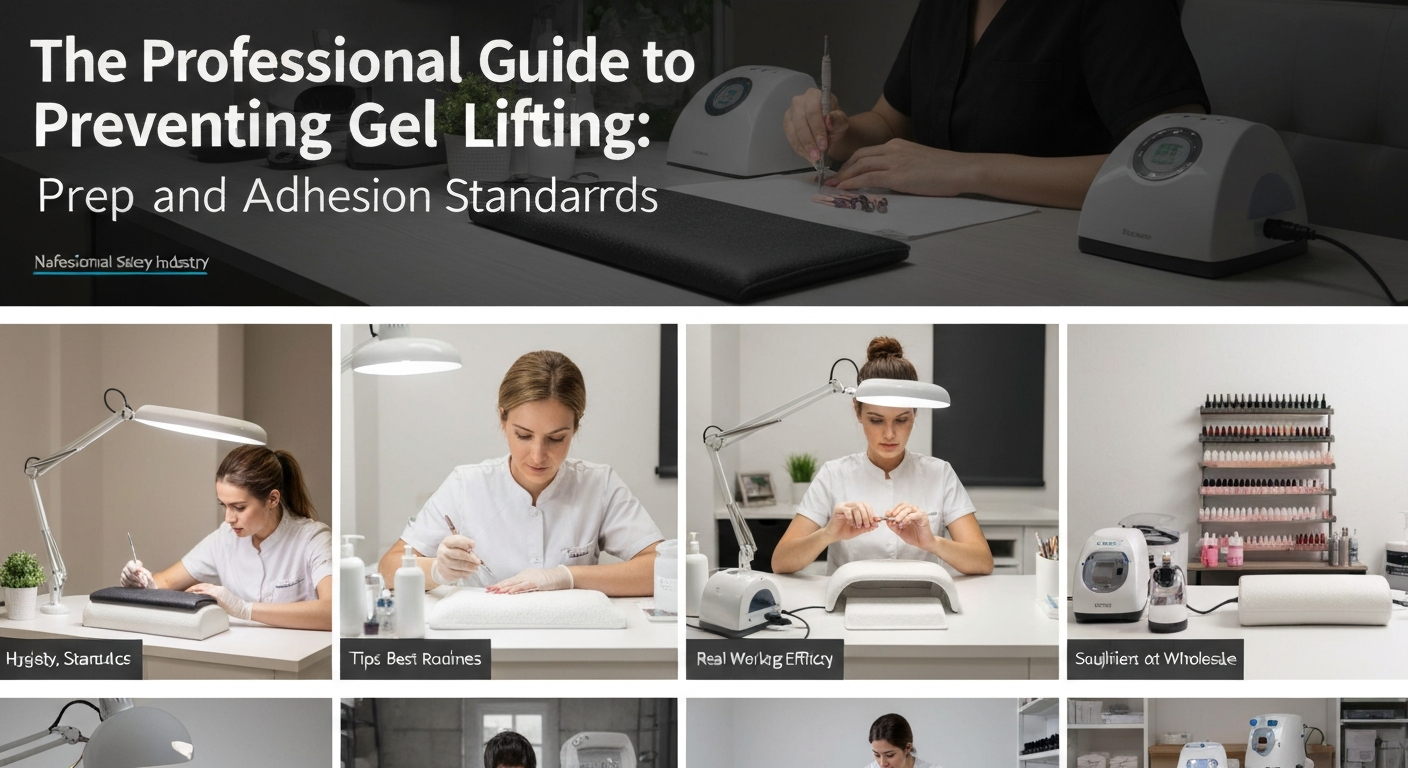
The Professional Guide to Preventing Gel Lifting: Prep and Adhesion Standards
For any professional nail technician, service breakdown is the ultimate enemy. When a client returns with lifted gel polish or builder gel after only a few days, it affects your reputation and your revenue.
Lifting is rarely a product fault. In 90% of cases, it is a failure in the preparation process or application technique. Understanding the chemistry of adhesion and the mechanics of the natural nail plate is essential.
This guide outlines the industry standards for nail plate preparation to ensure maximum adhesion for gel systems, including gel polish, hard gel, and builder in a bottle (BIAB).
The Physiology of Adhesion: Why Gel Lifts
To prevent lifting, you must understand what prevents the product from bonding. The nail plate contains oils, moisture, and non-living tissue that act as barriers.
Gel products require a rough, dry, and clean surface to form a mechanical bond. If microscopic barriers exist, the polymerization process will not anchor the product into the keratin layers.
The most common culprits for premature lifting include:
- Remaining Pterygium: Invisible cuticle tissue left on the nail plate.
- Improper pH Balance: The nail surface is too alkaline or oily.
- Flooding the Cuticle: Product touching the proximal nail fold or sidewalls.
- Inadequate Curing: Weak lamps or improper hand placement.
Step 1: Pterygium Removal and Dry Prep
Water expands the nail plate. For gel services, dry manicuring is the industry standard to prevent trapping moisture under the coating. You must remove the true cuticle (pterygium), not just the eponychium.
Using Diamond Bits for Cuticle Work
An electric file (e-file) with high-quality diamond bits is the most efficient method for removing non-living tissue. Using a flame or needle bit allows you to clean the sinus areas effectively.
Follow these operational standards for safety and efficiency:
- RPM Speed: Keep your e-file between 5,000 and 8,000 RPM for natural nail prep.
- Angle: Keep the bit flat against the nail plate to avoid cutting “rings of fire.”
- Direction: Switch between Forward and Reverse (F/R) to lift the cuticle skirt and exfoliate the plate.
After e-file work, use a manual pusher or nippers to remove the lifted tissue. The nail plate should look chalky and matte near the cuticle area, indicating all tissue is gone.
Step 2: Surface Etching and Texture
Gel needs a textured surface to “grip.” However, over-filing damages the nail and thins the foundation, which actually causes more lifting because flexible, thin nails bend away from the rigid product.
Use a 180-grit sponge buffer or a specialized sanding band (fine grit) to gently remove surface shine. You are not removing layers of keratin; you are simply raising the scales of the nail plate.
Always dust thoroughly using a stiff manicure brush. Dust particles left on the plate create air pockets, leading to service breakdown.
Step 3: Chemical Preparation
Once the physical prep is done, you must alter the chemistry of the nail plate. This involves two distinct steps: dehydrating and priming.
Dehydrators (pH Bond)
Apply a scrub-fresh or pure acetone-based dehydrator. This strips surface oils and temporarily removes moisture. The nail should turn an opaque white immediately.
Primers and Bonders
Select the correct primer for your system. Do not mix brands, as chemical compatibility varies.
- Acid-Free Primer: Acts like double-sided tape. It leaves a sticky layer. Use sparingly; too much primer can actually cause slippage and lifting.
- Acid Primer: Rarely used for soft gels, but sometimes necessary for acrylics or clients with problematic adhesion (hyperhidrosis).
Pro Tip: Apply primer only to the natural nail plate. Do not touch the skin. Acid-free primer touching the skin can lead to long-term contact dermatitis.
Step 4: The Base Coat Application
The application of the base gel is the anchor of the service. A “scrubbing” technique is highly recommended for the base layer.
Take a small amount of base gel and use the brush to firmly massage it into the nail plate. This forces the uncured gel into the micro-grooves you created during the buffing stage.
Cure this layer for the full time recommended by the manufacturer (usually 30 to 60 seconds LED). Do not flash cure the base coat; it needs a complete polymer network to hold the structure layers above it.
Step 5: Controlling the Inhibition Layer
If you are applying a builder gel or a structure gel, the perimeter application is critical. The product must taper to nothing at the cuticle and sidewalls.
If product touches the skin, even slightly, it creates a ledge. As the nail grows out, this ledge catches on hair and clothes, pulling the product away from the nail plate.
Inspect your line of light before curing. If the reflection is broken near the cuticle, the product is uneven. Use a liner brush (00 or 5mm) to guide the gel perfectly around the perimeter without flooding the trench.
Summary for Salon Owners
If your salon is experiencing a high volume of repairs or lifting complaints, audit your team’s prep process. Ensure that e-file bits are replaced regularly (dull bits don’t remove tissue effectively) and that lamps are calibrated.
Adhering to these strict sanitation and preparation standards will increase client retention and establish your reputation as a high-quality nail business.
