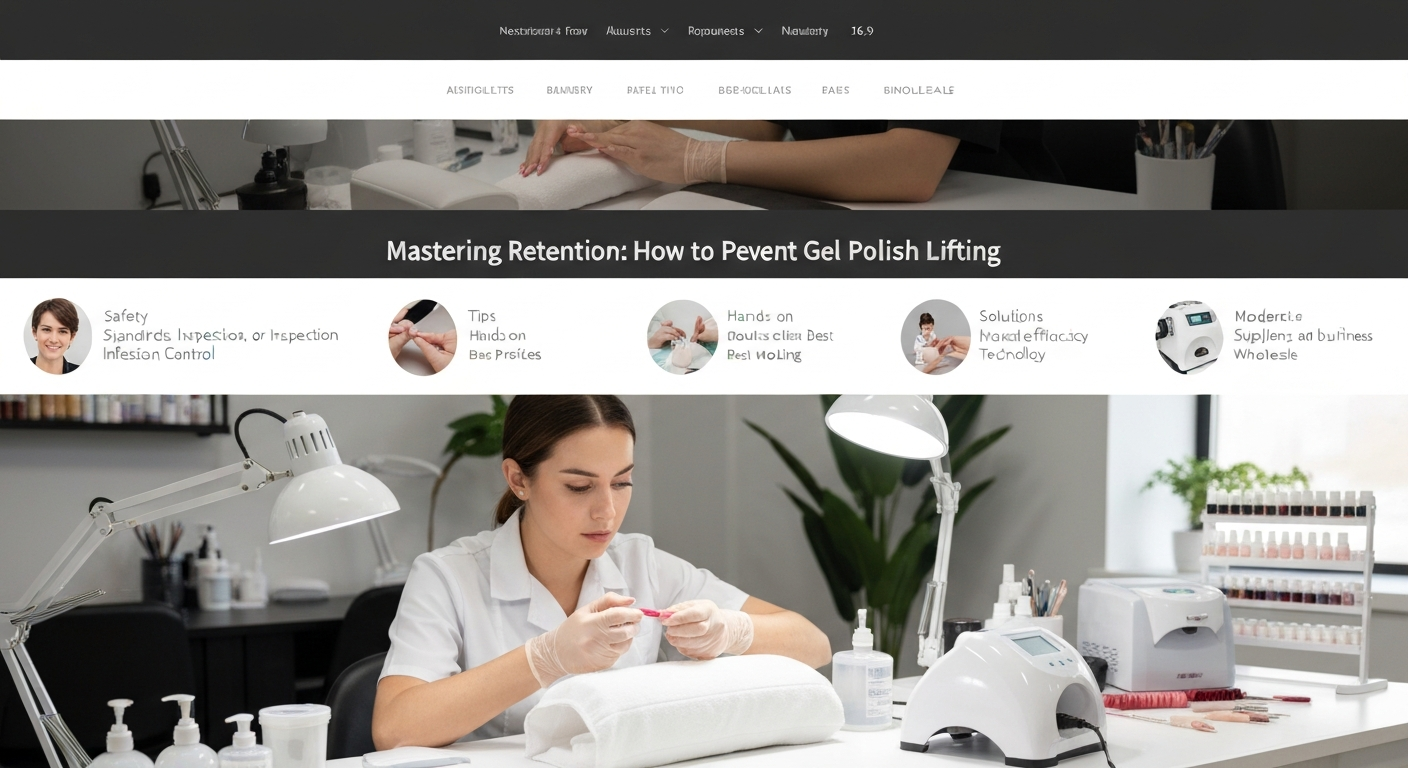
Mastering Retention: How to Prevent Gel Polish Lifting
Service breakdowns are the costliest issue in a nail salon. When a client returns with lifted gel polish after just a few days, it impacts your schedule, revenue, and professional reputation.
Lifting rarely happens due to “bad product.” In 90% of cases, the culprit is improper application or inadequate preparation of the natural nail plate.
Mastering the chemistry of adhesion and refining your workflow will ensure your gel services last three weeks or more, keeping your books full and clients happy.
The Science of Adhesion Failure
To prevent lifting, nail technicians must understand why it occurs. Gel polish requires a clean, dry, and textured surface to bond with the keratin of the natural nail.
Any barrier between the gel product and the nail plate will cause separation. This separation allows moisture and bacteria to enter, leading to lifting and potential “greenies” (pseudomonas).
Invisible Cuticle on the Nail Plate
The most common cause of lifting is non-living tissue left on the nail plate. The eponychium protects the matrix, but the true cuticle acts as a seal that grows out with the nail.
Even microscopic remnants of this tissue create a barrier. If you apply base coat over cuticle tissue, the product will lift as the skin naturally sheds oils and moisture.
Improper Curing and Lamp Output
Undercuring is a major safety hazard and a primary cause of service breakdown. If the photoinitiators in the gel do not receive sufficient UV energy, the polymer chain remains weak.
Always check your lamp’s wattage and wavelength compatibility with your chosen gel system. Bulbs degrade over time, leading to invisible curing issues that manifest as lifting.
Essential Prep Protocols for Maximum Retention
Your preparation steps determine the longevity of the set. A dry manicure is the industry standard for gel services because water expands the nail plate, causing shrinking and lifting later.
Mechanical Preparation
Surface Texture: Use a 180-grit sponge buffer or a mild sanding band on your e-file. The goal is to remove surface shine, not to thin the nail plate.
Dust Removal: Dust is an enemy of adhesion. After buffing, thoroughly scrub the nail with a stiff manicure brush and pure acetone or 99% Isopropyl Alcohol (IPA).
Chemical Preparation
Using the right liquids ensures the nail surface is chemically ready for the base coat.
- Dehydrator: Removes temporary surface moisture and oil. Wait for the nail to turn chalky white.
- Primer: Acts as “double-sided tape.” Use acid-free primer for standard clients. Use acid-based primer sparingly for clients with hyperhidrosis (sweaty hands).
Application Techniques to Stop Lifting
Once the prep is flawless, your application technique must be precise. The “less is more” rule applies heavily to soft gel systems.
The Proximal Fold and Sidewalls
Touching the skin with uncured gel is the fastest way to cause lifting. Once product touches the skin, capillary action pulls it away from the nail plate once cured.
Leave a tiny margin—about the width of a hair—between the product and the proximal nail fold. This ensures a clean grow-out and prevents immediate lifting at the cuticle area.
Capping the Free Edge
Shrinkage occurs as gel polymerizes. If you do not seal the free edge, the gel pulls back, exposing the natural nail tip to water and physical trauma.
Technique tip: Cap the free edge with the base coat and the color coats. Avoid capping with the top coat if it is too thick, as this creates a bulbous tip that chips easily.
Troubleshooting Problem Clients
Sometimes, a client follows all aftercare and you follow all protocols, yet lifting persists. In these cases, assess the natural nail condition.
- Thin, flexible nails: Standard gel polish may be too rigid. Switch to a rubber base or builder-in-bottle (BIAB) to provide flexibility that moves with the natural nail.
- Ski-jump nails: These require structure correction. Without an apex, the stress area takes too much pressure, causing the product to pop off at the cuticle.
By strictly adhering to dry manicure methods, thorough chemical prep, and precise application, you can virtually eliminate lifting from your salon services.
