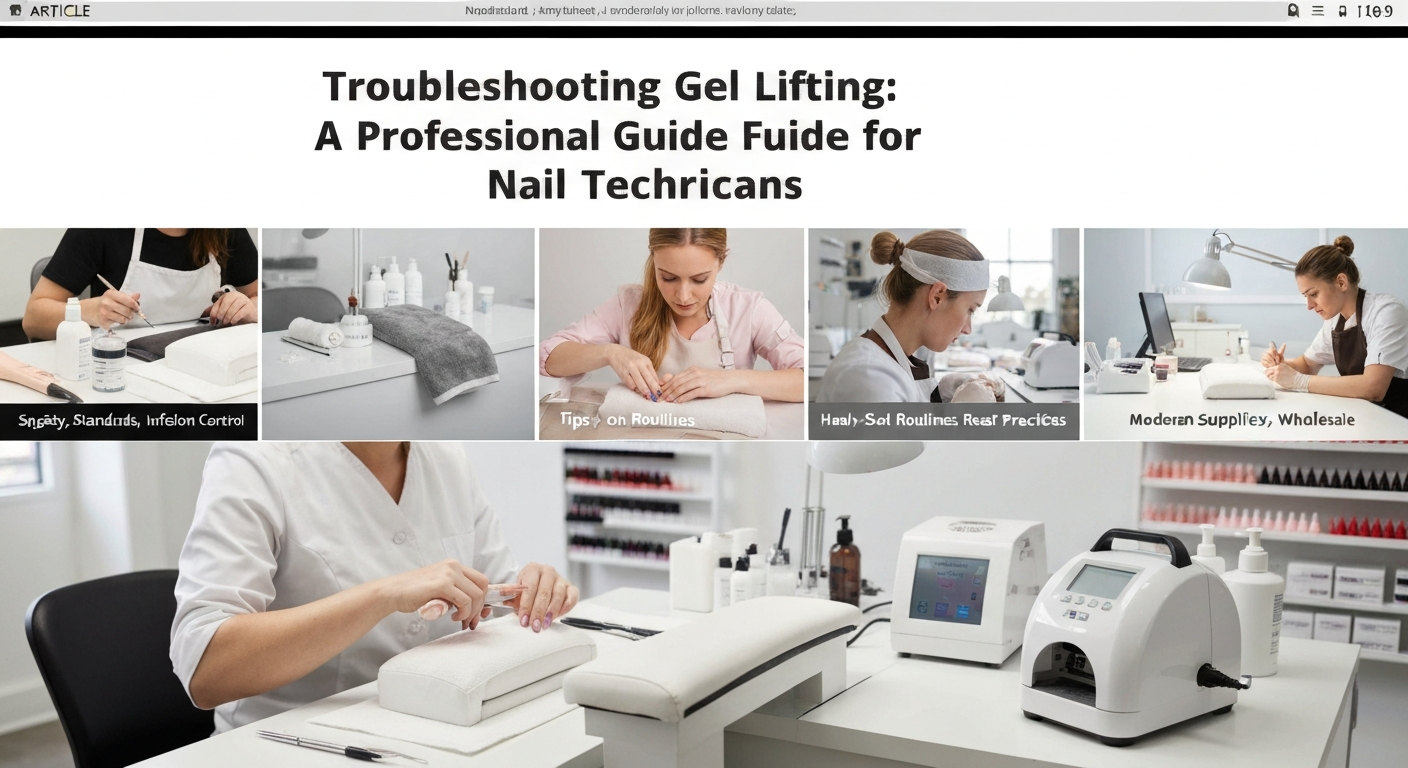
Troubleshooting Gel Lifting: A Professional Guide for Nail Technicians
Lifting is the number one service complaint in nail salons. It costs technicians time, money, and client trust when repairs are constantly required.
Understanding why products detach from the natural nail is critical for your business. It is rarely the product brand, and almost always the application technique.
Mastering adhesion requires a deep understanding of nail plate chemistry and mechanical preparation. Follow these industry standards to secure your retention.
The Foundation: Precision Nail Preparation
Industry statistics show that 90% of service breakdown occurs due to improper preparation. The nail plate must be completely free of all oils, contaminants, and dead tissue.
Skipping steps during the prep phase guarantees service failure. You must establish a consistent, thorough workflow for every client.
True Cuticle Removal
Technicians must differentiate between the living eponychium and the true cuticle. True cuticle is the non-living tissue firmly attached to the nail plate.
Use a stainless steel pusher or a diamond electric file bit to gently exfoliate this tissue. Any remaining non-living tissue acts as a barrier, causing the gel to lift immediately.
Ensure you check the lateral folds and sinuses. These are common lifting points where debris often hides.
Surface Texture and Dehydration
Buffing the nail is not about thinning the plate, but removing surface shine. This creates micro-channels that allow the base coat to grip effectively.
Use a 180-grit sponge buffer or a fine sanding band. Apply light pressure to avoid damaging the dorsal layer of the natural nail.
Thoroughly cleanse the plate with 99% Isopropyl Alcohol or a professional scrub. Dehydrators and acid-free primers are essential for clients with prone-to-lift or oily nail plates.
Application Techniques to Secure Longevity
Control is everything in gel application. The product must stay exactly where you place it to ensure a proper bond and safe regrowth.
Applying product too thickly prevents proper polymerization. This leads to uncured gel in the center, which causes lifting and increases the risk of contact dermatitis.
Avoiding the Eponychium
Flooding the skin or cuticle area is a guaranteed way to cause lifting. Once the gel touches the skin, oil from the skin wicks under the product, breaking the seal.
Leave a hairline margin between the product and the skin. This allows for clean grow-out and prevents irritation.
If gel accidentally touches the skin, clean it immediately with a cleanup brush dipped in alcohol before the client places their hand in the lamp.
Capping the Free Edge
Sealing the free edge is a standard step often rushed in busy salons. You must cap the edge on the base coat, color, and top coat layers.
This technique prevents shrinkage at the tip. It creates a watertight seal that protects the bond from daily wear and water absorption.
For clients with short nails, use a detail brush to cap the edge without getting product on the hyponychium.
Curing Lamp Standards and Maintenance
Your curing unit is the most important tool for retention. If the gel does not cure to 100%, the bond will fail within days.
Your lamp must match the nanometer wavelength required by your specific gel system. Mismatched wavelengths result in under-cured product, even if the gel feels hard.
Check your LED or UV bulbs regularly for dimming or dead spots. Weak bulbs lead to service breakdown and potential allergies for your clients.
Client Aftercare Education
Retention is a partnership between the nail technician and the client. You must educate clients on how to treat their nails between appointments.
Advise clients to use high-quality cuticle oil daily. This keeps the product flexible and prevents the natural nail from curling away from the gel.
Instruct clients never to use their nails as tools. Opening cans or picking at labels causes stress fractures in the gel, leading to eventual lifting.
