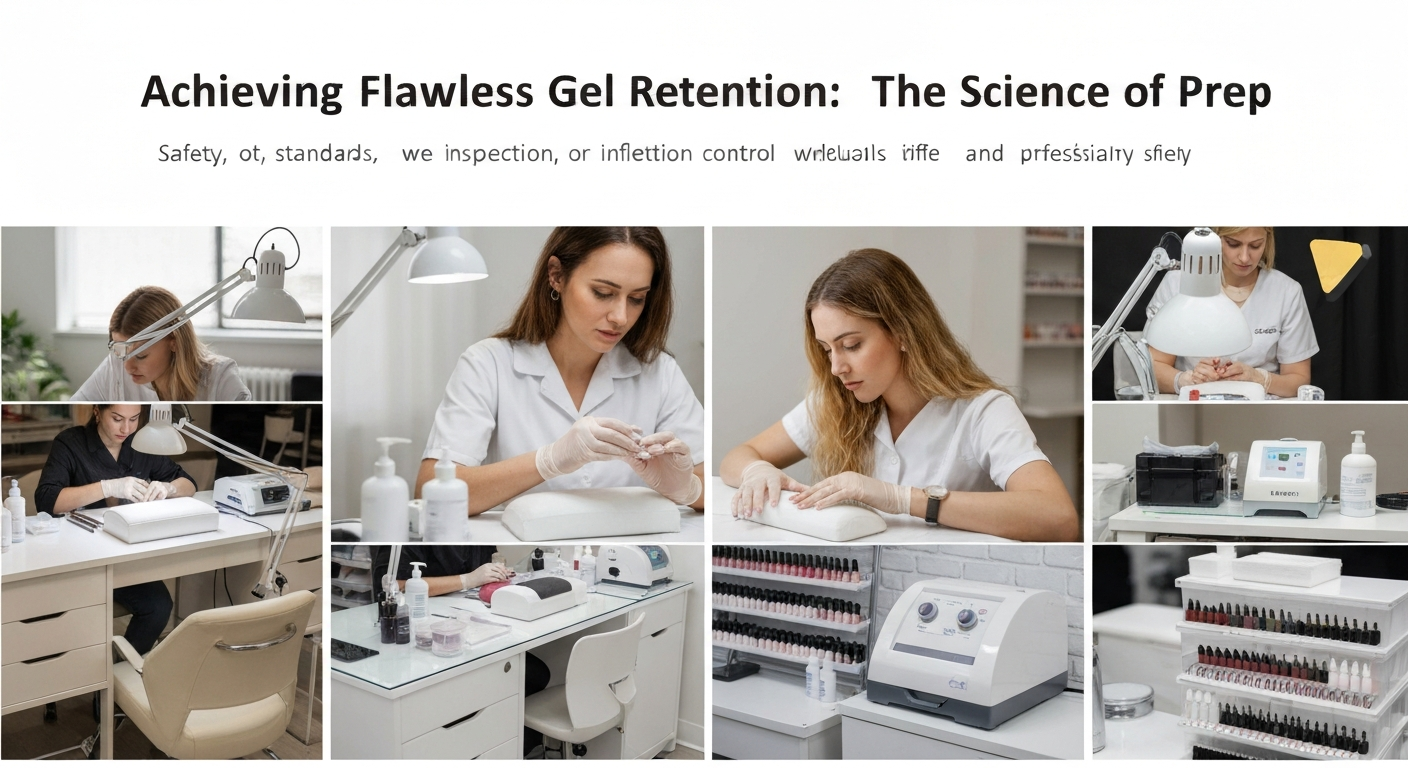
Achieving Flawless Gel Retention: The Science of Nail Prep
Premature lifting is the single most frustrating issue for both nail technicians and clients. It compromises the structural integrity of the enhancement and leads to dissatisfied customers.
Achieving four-week retention requires more than just high-quality gel products. It demands a rigorous understanding of the natural nail plate and proper chemical preparation.
By refining your preparation workflow, you can eliminate lifting, prevent “greenies” (pseudomonas), and build a reputation for long-lasting manicures.
Differentiating Cuticle from Eponychium
A common mistake in the nail industry is misidentifying the tissue being removed. The proximal nail fold is living tissue that seals the matrix and should never be cut aggressively.
The true cuticle is the thin layer of non-living tissue that sheds from the underside of the nail fold and rides out on the nail plate. This transparent film is the primary enemy of adhesion.
If any dead cuticle tissue remains on the nail plate, your product will bond to the skin instead of the keratin. As the skin sheds naturally, the product will lift away.
Mechanical Preparation: Creating the Surface
Gel products require a textured surface to form a mechanical bond. However, over-filing damages the nail plate and thins the foundation, leading to flexibility and service breakdown.
Use a 180-grit or 240-grit buffer or file to gently remove the surface shine. The goal is to raise the keratin scales slightly, not to remove layers of the nail plate.
Expert Tip: When using an e-file, a diamond bit at low RPM (5,000 to 7,000) is effective for exfoliating the cuticle area without damaging the natural nail.
Chemical Preparation: pH Balance and Priming
Once dust is removed, chemical preparation begins. This step alters the nail plate chemistry to make it compatible with artificial nail systems.
Dehydration
A pure dehydrator (typically acetone and isopropanol based) removes surface moisture and oils. This is temporary; the nail will rehydrate within minutes.
Apply the dehydrator liberally to the nail plate. Ensure it evaporates completely, leaving a chalky white appearance, before proceeding to the next step.
Primers and Bonders
Primers act as double-sided tape, bonding the natural keratin to the synthetic gel product. Choose the correct primer for your specific system.
- Acid-based primers: Corrosive and effective for problem lifters, but used less frequently in modern gel services.
- Acid-free primers: The industry standard. They act like a sticky layer for the base coat to adhere to.
The “Scrubbing” Application Method
How you apply your base coat is just as critical as the prep. A “floating” application often fails to penetrate the surface texture you created.
Use a short, flat gel brush to firmly “scrub” the base gel into the nail plate. This forces the product into the micro-grooves of the keratin layers.
After the scrub layer, cure fully according to the manufacturer’s instructions. Do not flash cure this foundational layer, as under-curing causes chemical sensitivities and lifting.
Controlling the Cuticle Area
Flooding the sidewalls or cuticle area creates a ledge of cured product touching the skin. This will inevitably cause lifting as the nail grows out.
Leave a tiny margin (hairline space) between the product and the skin. Use a liner brush to refine the perimeter of your base and builder gel application.
If product touches the skin, clean it immediately with a brush dipped in alcohol before the hand enters the LED/UV lamp.
