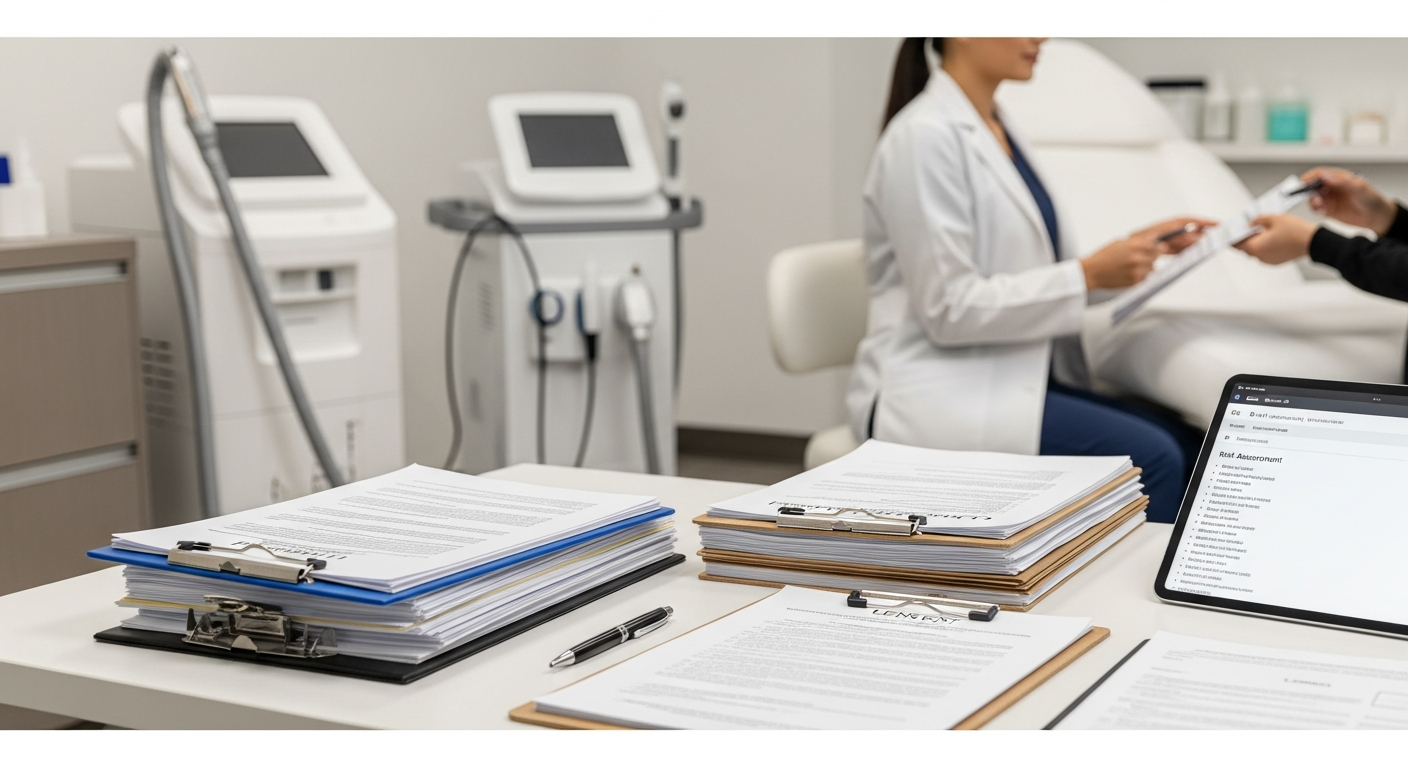
Med Spa Risk Management and Liability Protection
Med spa risk management is a proactive operational framework designed to identify, assess, and mitigate potential legal and clinical liabilities in aesthetic practices. By implementing standardized documentation, rigorous informed consent protocols, and incident reporting systems, med spas ensure compliance with U.S. regulatory standards while minimizing exposure to malpractice claims and administrative penalties.
Standardizing Informed Consent Documentation
Informed consent is the foundation of med spa risk management.
It ensures patients understand the specific risks, benefits, and
alternatives associated with any aesthetic procedure.
A legally sound consent form must be procedure-specific.
Generic forms fail to address the unique complications of
treatments like neurotoxins, dermal fillers, or laser therapy.
Practitioners must document the verbal conversation held with
the patient. This includes answering patient questions and
verifying their understanding before any treatment begins.
Recordkeeping Standards for Compliance
Consistent recordkeeping protects the med spa during audits or
legal disputes. Every patient file must contain a complete
medical history and a clear treatment plan.
Maintaining Comprehensive Treatment Logs
Each entry should detail the products used, lot numbers,
injection sites, and specific device settings.
Accurate timing and clinician signatures are mandatory.
Photography is a critical component of med spa recordkeeping.
High-quality “before and after” photos provide objective
evidence of treatment outcomes and baseline conditions.
Incident Reporting and Adverse Outcomes
Med spas must have a structured system for documenting
unexpected results. An incident report should be
completed immediately after an adverse event occurs.
The report must include the date, the specific procedure
performed, and a factual description of the complication.
Avoid documenting subjective opinions or assigning blame.
Managing Patient Complications
When an adverse outcome is identified, the med spa must
follow a formal clinical protocol. Document all follow-up
care, instructions given, and subsequent patient interactions.
Timely communication with the medical director is essential.
The medical director should oversee the clinical response
to ensure patient safety and reduce further liability.
Liability Reduction Frameworks
Establishing a liability reduction framework involves
regularly auditing patient charts for missing signatures.
Consistent audits ensure the facility meets regulatory standards.
- Credential Verification: Confirming all providers hold valid state licenses.
- Policy Manuals: Maintaining written protocols for every procedure offered.
- Scope of Practice: Ensuring staff only perform tasks permitted by state law.
Effective med spa risk management relies on staff training.
Every team member must understand their role in maintaining
documentation accuracy and patient safety protocols.
